by Ben Tolkin
How can floating underwater mimic the zero gravity condition of outer space? - Samantha Zhang, age 10
Going into space is hard. Really, really hard. Astronauts work with some of the most complicated and expensive
technology ever made, in an environment that's both highly dangerous and completely unlike anything they're used to. If
you make a mistake on a space station hundreds of miles above the Earth, you might not get a second chance to make
things right. Before going into space, you have to make sure you can do every part of your mission perfectly, 100% of the
time, and that means practice, practice, practice.
Unfortunately, there’s no easy way to train for space travel; outer space is (literally!) like nothing on Earth.
Sunday, March 20, 2016
Thursday, March 17, 2016
Don't Forget to Pre-Register for Science Festival Programs!
We have more than 170 events lined up for April 15 - 24 this year! Many of these events need notice that you're going to attend.
Take a look at the list below for all the festival programs that require pre-registration, tickets, or request an RSVP.
Don't miss the School Vacation Programs category as well!
(Please note: MIT Museum workshops open registration on March 28.)
Take a look at the list below for all the festival programs that require pre-registration, tickets, or request an RSVP.
Don't miss the School Vacation Programs category as well!
(Please note: MIT Museum workshops open registration on March 28.)
Programs with pre-registration or tickets
Wednesday, March 16, 2016
Artists, Scientists, and Both: Creative Thinking on BOTH Sides of the Brain
By E. Rosser
Science is often thought of as a purely left-brain venture...but who says the creative thinking that leads to great discoveries can’t also produce some great art? The Cambridge Science Festival aims to show off the “A” part of “STEAM” by urging Festival-goers let their inner DaVinci out at our various art events--from crafting kinetic sculptures to learning about baby birds through drawing. It turns out that innovation and passion are important ingredients for art as well as science, technology, math, and engineering.
“The greatest scientists are artists as well.” --Albert Einstein, 1923
Science is often thought of as a purely left-brain venture...but who says the creative thinking that leads to great discoveries can’t also produce some great art? The Cambridge Science Festival aims to show off the “A” part of “STEAM” by urging Festival-goers let their inner DaVinci out at our various art events--from crafting kinetic sculptures to learning about baby birds through drawing. It turns out that innovation and passion are important ingredients for art as well as science, technology, math, and engineering.
Some of the greatest minds that science has seen have also been known to stretch their artistic muscles. Here are some famous scientists who have put down the lab notebook and picked up the sketchpad over the years--and artists who have taken up science!
Drawing and Illustrating:
Tuesday, March 15, 2016
TENacious Engineering at the MIT Museum: Collaboration, Learning, and Innovation in Chain Reactions
by Marybeth Martello, Ph.D.
This post is one in a series of posts about the
Cambridge Science Festival’s TENacious Engineering Project (see blog entry from
February 17, 2016). To celebrate the
Festival’s TENth Anniversary, TEN teams across the state are building TEN chain
reaction machines. These machines are
reminiscent of the contraption that kicked off the very first Festival. On the evening of April 15, at the Big Ideas
for Busy People Event, Governor Charlie Baker will open the Festival with a
short film that links all of these machines together.
Why chain reactions, you might ask? With so many worldly problems begging for our attention, why spend precious time and brain power figuring out ways to make objects (often discarded and unwieldy items) perform tasks for which they were not designed? The talented team of artists, scientists, and students, who recently constructed a TENacious Engineering chain reaction in the MIT Museum’s lobby, offered some compelling answers to these questions.
Monday, March 14, 2016
Curiosity Challenge: Weather and Animals in Antarctica
"What's the weather like in Antarctica?" -- Aaliyah Bester, 7
"How do animals survive in the Antarctic?" -- Josephine Sawyer, 8
Why did she have to go all the way to the bottom of the globe to use a telescope? The answer has to do with Antarctica’s crazy weather.
"How do animals survive in the Antarctic?" -- Josephine Sawyer, 8
| My friend Rachel stands on the bottom of the world with the Geographic South Pole marker! Courtesy of Rachel Bowens-Rubin. |
The Antarctic is a really “cool” place--both because of how neat it is, and because it’s so cold! In fact, the coldest temperature ever recorded on Earth was −89.4 °C (−128.9 °F), at the Vostok Station in Antarctica. I’ve been hearing a lot about Antarctica lately because my friend Rachel has just returned from a trip to the South Pole, which is right in the middle of the continent. Rachel is an astrophysicist, which means that she studies the physics of stars and planets by looking at them through a telescope. She was using a telescope at the South Pole to search for special waves in space that might tell us more about how the universe was formed, as part of the awesome BICEP3 experiment.
![]() |
| Rachel helped build this part of the BICEP telescope, then fly it to Antarctica. Notice the heavy cold weather gear she had to wear, even while working. Courtesy of Rachel Bowens-Rubin. |
Choose YOUR Pi Ice Cream on Pi Day!
"Where will we see this festival ice cream anyway?"
Come to Big Ideas for Busy People or the Science Carnival & Robot Zoo to check out this new flavor in person!
See you at the Festival!
April 15 - 24, 2016
cambridgesciencefestival.org
Friday, March 4, 2016
Curiosity Challenge: "What is Global Warming?"
“What is Global Warming?” -- Madi Corvi, Age 12
You’ve asked a very important question, Madi, and one of my favorite topics to talk about! Lots of scientists have been wondering what has been causing the hottest years on record (most of which have been happening in the past decade), and if humans are part of the cause. They agree that the earth has been heating up and cooling because of natural reasons (like volcanic eruptions, or changes on the sun) for thousands of years...but the recent temperature increase has been sharper than ever before. Since that temperature spike has occurred during the time when humans have been on the planet, most scientists agree that humans are probably the cause. When talking about global warming, it’s important to make it clear whether we’re talking about natural climate cycles or anthropogenic--a word that means “caused by people”--climate change.
There are many, many things that affect how hot our planet it, but one of the biggest and most powerful is radiative forcing. Our atmosphere is a big, protective bubble made up of many gases, mainly oxygen, nitrogen, carbon dioxide, and water vapor. That bubble reflects some of the sun’s rays back into space, but also lets some through to warm up earth’s surface. The earth’s surface also reflects the rays back up to the atmosphere. Depending on what gases the rays meet in the atmosphere, they will either be trapped here on earth or let back out into space. You may have heard of the greenhouse effect before--the atmosphere acts like the glass in a greenhouse, trapping the sun’s rays to keep our planet warm. Rather than just letting rays pass through back out into space, these gases cause radiative forcing: they let in more rays than they let out.
The greenhouse effect and radiative forcing, in general, are good things! Think of how cold and plantless our planet would be if we had as much of the sun’s energy as the rest of space does. However, the gases in the atmosphere have been gradually changing. Namely, lots more carbon dioxide, methane, and nitrous oxide have been released, most likely from human activity. These greenhouse gases in particular are very good at increasing radiative forcing, and as they do, they warm up the planet.
| The Greenhouse Effect, with natural and anthropogenic amounts of greenhouse gases. Via LiveScience.com |
The atmosphere isn’t the only place where global warming is caused, though. Like knocking over a chain of dominoes, a hotter globe means that even more greenhouse gases are released than normal, which further increases radiative forcing. Melting ice caps mean that less of the globe is covered in ice, which means that more of the sun’s energy reaches the ocean. Oceans are usually able to absorb much of the globe’s carbon dioxide, but they become less able to do so the warmer they get. What’s more, as the algae and bacteria floating in the ocean and trapped in the ice die and decompose, they release methane, another greenhouse gas that’s even better at radiative forcing than carbon dioxide! It’s a vicious cycle, one that scientists call a positive feedback loop.
| An example of a climate positive feedback loop. Via theday.co.uk |
Some people like to joke about climate change--you’ve probably heard people mention how they’d like it to be summer all year-round, or that a warmer winter means less snow to shovel. But the planet warming, even by a few degrees, could have serious consequences. Melting icecaps and ocean water expanding as it warms could cause sea levels to rise, flooding seaside cities and island nations. Many plants and animals, already stressed because of their shrinking habitats, aren’t used to living on such a hot planet, and might become extinct. Even humans aren’t used to living in that kind of heat: farming methods rely on our current temperatures, so a hotter globe could mean food shortages, especially in the poorest parts of the world. Nearly every aspect of life on earth will be affected by the global temperature rising. If humans continue releasing as many greenhouse gases as they currently do, scientists estimate that the temperature will rise by about 5 degrees Celsius (about 9 degrees Fahrenheit) by 2100. This will trigger enough positive feedback loops to turn most of the globe into a desert.
| Some effects of a global temperature increase. Via www3.epa.gov |
| From one of my favorite Doctor Suess books, The Lorax. Via Quotesgram.com |
Talking about climate change and its results can be really scary. Whenever I stop and think about the massive scale of the problem, I feel like there’s nothing that I can do to stop it. Even if I do things that we’ve always thought of as “good for the planet,” like recycling, driving less, and using less electricity, will it be enough? Probably not. Can I single-handedly stop everyone from releasing carbon dioxide, when most of our power system relies on burning coal and oil? Definitely not. But the good news is that the most powerful thing to stop global warming is something we can do: we can tell others what we know about the science of climate change. If enough people care about lowering greenhouse gas emissions and keeping the planet cool, they will make more climate-friendly decisions, and encourage governments and world leaders to do so, as well.
It will be difficult to change how we live and use the planet, but if enough people care, it’s a change we can make together!
Resources to learn more:
- Surging Seas, a risk-zone map by Climate Central. See how a rising sea level would affect your neighborhood.
- Climate Kids by NASA has lots of great articles and games to learn more about climate.
- Our Time to Lead, Climate.gov's youth coverage of COP-21, the most recent international climate summit in Copenhagen
- The EPA offers some suggestions for actions you can take to shrink your carbon footprint.
- The Greenhouse Gamble, a nifty way to model scientific uncertainty when it comes to complicated issues like climate change, developed by MIT's Joint Program on the Science and Policy of Global Change.
- Interested in becoming a climate scientist? Come learn more about science, technology, engineering, arts, and math at the Cambridge Science Festival from April 15-24!
-------------------
E. Rosser is a science writer and mechanical engineer currently wrapping up a degree at MIT. She thinks climate change is the most pressing--and most exciting--challenge facing the world today, and that we'll solve it only through science education. When Rosser's not blogging or in school, she likes to embark on zany building projects and play with her two pet rats, Ellen and Darwin.
Wednesday, March 2, 2016
How big were T. Rex's feet?
In our Curiosity Challenge Series...
How big were T. Rex’s feet?
Question submitted by Aidan Barry, Age 5
Great question, Aidan! While not the biggest carnivorous dinosaur (that distinction belongs to the Spinosaurus), Tyrannosaurus Rex (T. Rex) is arguably the most popular. It is estimated that an adult T. Rex was roughly twelve feet tall - more than double the height of the average American male adult - and weighed about seven tons (about the weight of an African elephant). We often think about - and mock! - the puny size of T. Rex’s arms, but its feet were decidedly more impressive. Foot size can be estimated by looking at a T. Rex skeleton and by measuring T. Rex footprints.
No complete T. Rex skeleton has ever been found (the closest we’ve gotten is Sue, the resident T. Rex at the Fields Museum in Chicago, who is about 90% real bone). STAN, the resident T. Rex at the Black Hills Institute of Geological Research, is about 65% real bone. Fully extended, STAN’s feet were each about 4 feet long. In other words, STAN’s feet were the same length as an average sleeping seven year old human! Unlike humans, STAN’s heels would not have touched the ground while walking. Interestingly, there are only two known T. Rex footprints. The more recent one was identified in Montana in 2007 and clocked in at 3 feet wide. Like humans, T. Rex foot size likely varied based on factors such as age, which means that there might be as yet undiscovered T. Rex skeletons with even bigger feet than STAN!
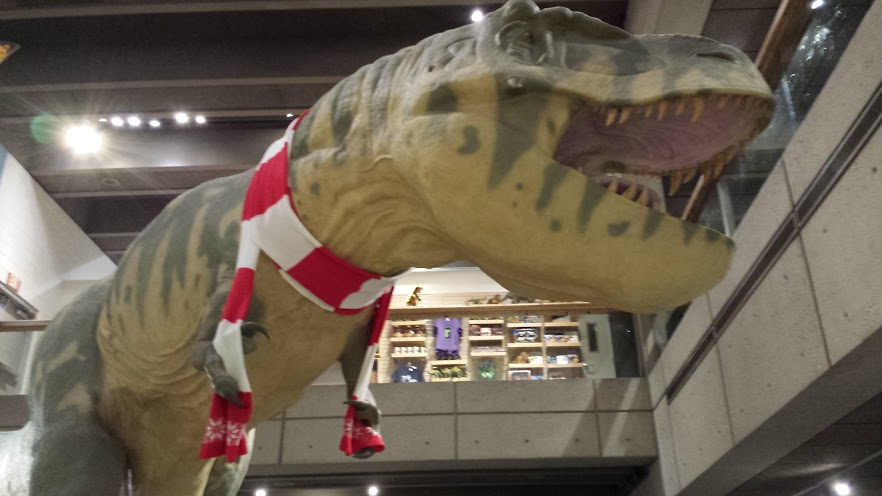
The Friendly Neighborhood T. Rex at the Boston Museum of Science (image courtesy of the author)
In spite of its gigantic feet, T. Rex was not a particularly fast walker. Paleontologists believe that T. Rex probably walked at a pace of about 2.7 to 5 miles per hour; the average adult human walking pace is about 3 miles per hour.
For more information on dinosaurs, check out the permanent local exhibits at the Boston Museum of Science and the Harvard Museum of Natural History. And if you’re interested in checking out some actual dinosaur footprints, check out the Dinosaur State Park in neighboring Connecticut!
Saheli Sadanand is a post-doctoral fellow at the Ragon Institute of MGH, MIT and Harvard. She’s always loved dinosaurs - her favorite is the Spinosaurus - and still harbors dreams of going on a dino dig someday!
Subscribe to:
Posts (Atom)