“I’ll bet you that my HOUSEKEEPER can do a better job!”
This – or something like this – was apparently the line yelled at a male assistant by Edward Pickering, head of the Harvard Observatory, in 1877.
No one knows what blunder sparked the outburst, though we can bet that it was a whopper, given that women weren’t allowed even to operate a telescope at the time.
But we do know that Pickering made good on his bet – first hiring his housekeeper, and then many other women, to measure the brightness of stars – and that winning it would prove to be probably his greatest contribution to science.
Two of “Pickering’s harem” would devise entire new and efficient ways to classify the stars, while a third – Henrietta Leavitt - would do nothing less than revolutionize the way humans measured and understood their universe.
(Edwin Hubble would simply use Leavitt’s ideas and the world’s best telescope to make “the discovery of the century” in the 1920s – that our universe is filled with galaxies like our own, and is expanding.)
Still another woman, Cecilia Payne, would later come to Harvard to join the world’s most female-dominated science lab in the world, and discover for the first time what stars are really made of.
As a Harvard astronomy undergrad, I first heard the story of “Pickering’s women” in class, from one of their modern-day sisters: planet-hunting astrophysicist Dr Lisa Kaltenegger.
Wow, I thought.
Why wasn’t there a movie?
Of course, it was tough enough for women to get their hands on scientific instruments 100 years ago, far less the credit for their work. (Come to think of it, almost all the credit for Rosalind Franklin’s iconic discovery in biology – the crystalline structure of DNA – went to Watson and Crick just 50 years ago, so what’s new).
The Cambridge Science Festival will offer three sessions which celebrate women in cutting-edge science: “Inquiring Minds”, to be held from April 29 to May 1 at the Boston Museum of Science. The dozen speakers represent a remarkable diversity of scientific talent, from marine biology to chemistry and aerospace design.
But, for me, the thread of female scientific genius can be followed just as easily at any of the six astronomy-related events at the Festival, including “80 Years of Astronomy” (April 24), "From the Mysteries of the Brain to the Wonders of the Universe," (April 24) and “Cambridge Explores the Universe” (May 1).In fact, if they keep their eyes peeled, visitors to the latter – held at the Harvard Observatory – might find the names of two of the women I mention in this blog attached to two of the instruments they’ll get to play with (I ain’t sayin which).
“Cambridge Explores the Universe” is likely to be the most family- and fun-oriented of the astronomy events, with telescope tours, planetarium shows and even the chance to operate a robotic telescope at the MicroObservatory during the four hours of the open-house.
But there are some truly jaw-dropping story-lines behind the discoveries made at this place since 1839, and I’m particularly looking forward to the “Scientist Café” – where you’re invited to collar any of the working astronomers over a coffee and get them to give you an insider’s tale.
First, back to 1877: Asked to plot the brightness of stars onto photographic plates, here was the problem that Pickering’s blundering male assistant confronted: the brightness of the star on the photograph didn’t really tell you anything about it.
That’s because – unless it was a very nearby star, like Sirius - you had no idea of knowing how far it was from the earth.
Imagine being asked to measure all the lights from a photograph of an ocean scene on a moonless night.
The brightest one could be a 30 watt flashlight held in a life raft, 10 yards in front of the camera, and the dimmest could easily be a million candle-power lighthouse 3 miles away.
Using a combination of herculean patience and stunning insight, Leavitt discovered a pattern in a variety of star called "cepheids" which revealed their true power.
(Like a bell: the bigger the star, the slower its vibration cycle from bright to dim and back to bright.)
Although exploding stars are now used to measure the farthest distances, “Leavitt’s Law” – the relation between “period and luminosity” -remains the most accurate measuring tape in the universe.
But what about all the other stars? The ones that didn’t vibrate so reliably?
Again, “Pickering’s women” found the answer.
According to Debra Davis – editor of Woman Astronomers – his housekeeper, Williamina Stevens, and her unborn child had been abandoned by her husband just months after arriving in the US, and she was eager to find some means of financial independence.
Formerly a teacher in Scotland, Stevens proved so expert at plotting the brightness of stars on her boss’s photographic plates that she headed a project to survey the entire night sky (funded by another woman of central importance to astronomy: Anna Draper) and was appointed Harvard’s Curator of Astronomical Photographs.
Within 10 years, yet another female colleague, Annie Jump Cannon, invented an efficient new way to classify all stars at Stevens’ urging, and perhaps the most famous string of letters in all of science – “OBAFGKM”- to describe how they are organized.
As it turned out, nature would reward Cannon’s idea with an almost magical symmetry in the way that all “healthy” stars are arranged.
Incredibly, stars which are divided into groups of OBAFGKM (our Sun is a “G” star) by the fingerprint-like characteristics in their light, called “spectral lines”, can be arranged exactly the same way no matter if you’re dividing them by their size, their color, their total power output; their mass, their temperature, or even their life expectancy. (So all “O” stars will live shorter lives than all B stars, which will live shorter lives than A stars, etc. And O stars will also be bluer in color (And hotter. And bigger) than B stars, which will be bluer in color (And hotter. And bigger) than A stars, etc, etc.)
So that’s the distances and types of stars taken care of by Pickering’s pioneers.
But what about what they’re actually made of? (And most of the universe, for that matter)
Within three years of her arrival in Harvard from England – but working for Pickering’s successor - Cecilia Payne stunned the science world with an answer no one could challenge.
While her male counterparts had long insisted they were mostly made of iron, Payne proved it was hydrogen.
Other aspects of her research would form the foundation of the modern picture of how planets form, and how the elements are made.
And yet Payne was rated no higher than a “technical assistant” by her male director for 13 years after her groundbreaking discovery.
In the end, the pieces of knowledge we have about Harvard’s women astronomers are a lot like the faint points of starlight on their telescope plates: the blurred and often overlooked evidence of searing power.
I'd really welcome any comments or additional info folks might have about female astronomers.
Next week: I reveal how visitors will come face to face with a real, working time machine at the Festival.
Thanks for reading; cheers - Rowan
* (Rowan Philp is a Knight Science Journalism Fellow at MIT)

Friday, April 2, 2010

Thursday, April 1, 2010
The “Coolest” Way to Make Ice Cream
What is the secret to delicious and quick homemade ice cream? Liquid nitrogen.
Don’t believe me? Stop by the Cambridge Public Library between noon and 4pm on Saturday April 24--the Science Carnival is hosting an event called “Liquid Nitrogen Ice Cream Making!” where YOU not only get to witness the amazing spectacle of making liquid nitrogen ice cream, but also get to consume the delicious final product.
It’s a pretty cool looking process. Here’s a photo from the first time I made liquid nitrogen ice cream:

Nitrogen is readily found in our atmosphere, but only in its gaseous state (incidentally, nitrogen gas makes up 70% of our atmosphere). Liquid nitrogen, on the other hands, does not occur naturally on Earth. Liquid nitrogen only exists under super-cold conditions. I’m talking -321°F cold, way colder than any place on Earth. By comparison, room temperature is around 70°F, and the coldest recorded air temperature on Earth was “only” -129°F (that honor went to Russia in 1983).
If liquid nitrogen hits any temperature above -321°F, it boils immediately into nitrogen gas. That’s why the ice cream looks like it is steaming in the above picture. Liquid nitrogen “steams” into gaseous nitrogen as it boils, just like how water steams into water vapor when it boils. Same concept and same process, except liquid nitrogen boils at a much lower temperature, and thus its “steam” is correspondingly much cooler. Colder things are denser than warm things, so while steam from water rises, the “steam” from liquid nitrogen sinks. (You can see this in the photo and at the festival!)
Due to liquid nitrogen’s coldness, you must handle it carefully with proper equipment, like gloves and specialized cold storage containers, and such matters will be properly taken care of at the Science Carnival.
But why use liquid nitrogen for making ice cream? It’s not necessary to have liquid nitrogen to make ice cream, but it certainly makes the task much easier (provided that you don’t have trouble acquiring liquid nitrogen).
Making ice cream sans liquid nitrogen is a slow process, one where you must churn the ice cream a lot while it is being cooled. This is the usual approach of ice cream making machines you find at factories and in home kitchens. Why the churning? For texture! We love ice cream not only for its flavor but also for its texture. Churning ice cream while it cools prevents it from solidifying into solid blocks--after all, eating rock-hard ice cream would be no fun. Churning also whips the ice cream, aerating it to the fluffy and smooth consistency we love. Like any recipe that involves a lot of aeration (ever tried making whipped cream or meringues, for instance?), this takes a while, but liquid nitrogen turns ice cream making into a snap.
The secret lies in the extreme coldness of liquid nitrogen. Boiling at about 400°F below room temperature, the transformation of nitrogen from liquid to gas form is incredibly violent. Think about a pot of boiling water on a stove. If you turn up the temperature on the stove, the water boils more violently. Same concept applies for liquid nitrogen (just at much cooler temperatures), thus liquid nitrogen boils with extreme ferocity: it fizzles and sizzles and immediately turns into vapor, like water splashed onto a very hot pan. This intense bubbling action serves as a whipping and aerating mechanism. All you need to do is create an ice cream base (a combination of milk, cream, sugar, and flavorings) and pour liquid nitrogen into the base while stirring, cutting down on the amount of work you need to do churning. Moreover, all of the liquid nitrogen evaporates, leaving you only with delicious ice cream.
Without a doubt, the “coolest” way to make ice cream is with liquid nitrogen.
Don’t believe me? Stop by the Cambridge Public Library between noon and 4pm on Saturday April 24--the Science Carnival is hosting an event called “Liquid Nitrogen Ice Cream Making!” where YOU not only get to witness the amazing spectacle of making liquid nitrogen ice cream, but also get to consume the delicious final product.
It’s a pretty cool looking process. Here’s a photo from the first time I made liquid nitrogen ice cream:

Nitrogen is readily found in our atmosphere, but only in its gaseous state (incidentally, nitrogen gas makes up 70% of our atmosphere). Liquid nitrogen, on the other hands, does not occur naturally on Earth. Liquid nitrogen only exists under super-cold conditions. I’m talking -321°F cold, way colder than any place on Earth. By comparison, room temperature is around 70°F, and the coldest recorded air temperature on Earth was “only” -129°F (that honor went to Russia in 1983).
If liquid nitrogen hits any temperature above -321°F, it boils immediately into nitrogen gas. That’s why the ice cream looks like it is steaming in the above picture. Liquid nitrogen “steams” into gaseous nitrogen as it boils, just like how water steams into water vapor when it boils. Same concept and same process, except liquid nitrogen boils at a much lower temperature, and thus its “steam” is correspondingly much cooler. Colder things are denser than warm things, so while steam from water rises, the “steam” from liquid nitrogen sinks. (You can see this in the photo and at the festival!)
Due to liquid nitrogen’s coldness, you must handle it carefully with proper equipment, like gloves and specialized cold storage containers, and such matters will be properly taken care of at the Science Carnival.
But why use liquid nitrogen for making ice cream? It’s not necessary to have liquid nitrogen to make ice cream, but it certainly makes the task much easier (provided that you don’t have trouble acquiring liquid nitrogen).
Making ice cream sans liquid nitrogen is a slow process, one where you must churn the ice cream a lot while it is being cooled. This is the usual approach of ice cream making machines you find at factories and in home kitchens. Why the churning? For texture! We love ice cream not only for its flavor but also for its texture. Churning ice cream while it cools prevents it from solidifying into solid blocks--after all, eating rock-hard ice cream would be no fun. Churning also whips the ice cream, aerating it to the fluffy and smooth consistency we love. Like any recipe that involves a lot of aeration (ever tried making whipped cream or meringues, for instance?), this takes a while, but liquid nitrogen turns ice cream making into a snap.
The secret lies in the extreme coldness of liquid nitrogen. Boiling at about 400°F below room temperature, the transformation of nitrogen from liquid to gas form is incredibly violent. Think about a pot of boiling water on a stove. If you turn up the temperature on the stove, the water boils more violently. Same concept applies for liquid nitrogen (just at much cooler temperatures), thus liquid nitrogen boils with extreme ferocity: it fizzles and sizzles and immediately turns into vapor, like water splashed onto a very hot pan. This intense bubbling action serves as a whipping and aerating mechanism. All you need to do is create an ice cream base (a combination of milk, cream, sugar, and flavorings) and pour liquid nitrogen into the base while stirring, cutting down on the amount of work you need to do churning. Moreover, all of the liquid nitrogen evaporates, leaving you only with delicious ice cream.
Without a doubt, the “coolest” way to make ice cream is with liquid nitrogen.
Famous Scientists in Five Minutes
In what ways do our friends influence us? How do our minds think about other people's minds? Where is the universe from - did it just come from nothing?
They're big questions, certainly. They can't exactly be figured out in an afternoon. But the Cambridge Science Festival is holding an event called "Big Ideas for Busy People" where these questions, and more, will start being answered.
In Big Ideas for Busy People, top scientists will talk about these ideas in the context of their own research at an evening event preceding the start of the Festival. Ten leading researchers from Harvard and the Massachusetts Institute of Technology will present their work in precisely five minutes each, with five minutes available for questions from the audience.
Ever wanted to know what will power cars in the next ten years? To get an idea of the event, one of the speakers is Angela Belcher, Professor of Biological Engineering and Material Science and Material Engineering at MIT. She studies how to turn viruses into tiny nanowires, and how these nanostructures can be put together to produce powerful batteries, and so for it she'll talk about how DNA can be used to create energy-storing devices.
I'm studying biology, so I'm especially excited for Rebecca Saxe's talk about how the brain thinks about abstract ideas and Ed Boyden's presentation on how brain circuits are connected. But the ten speakers will talk about a range of topics such as biology, sociology, physics and astronomy. Plenty of topics floating around!
The event is completely new and experimental, and since their task is to boil down years of research into five minutes, presenting it clearly and quickly enough for us all to understand, it'll be interesting to see how well these scientists can do it.
The world around us is fascinating - come learn about it! Hear straight from prominent scientists about life and the universe at "Big Ideas for Busy People" on Friday April 23. It is a two hour event for adult audiences beginning at 7:30 PM in The Laboratory, Northwest Science Building 52 Oxford Street, Cambridge, MA 02138.
To learn more about who's speaking at the event, read next week's post introducing another speaker, Nicholas Christakis, whose research focuses on social networks.
They're big questions, certainly. They can't exactly be figured out in an afternoon. But the Cambridge Science Festival is holding an event called "Big Ideas for Busy People" where these questions, and more, will start being answered.
In Big Ideas for Busy People, top scientists will talk about these ideas in the context of their own research at an evening event preceding the start of the Festival. Ten leading researchers from Harvard and the Massachusetts Institute of Technology will present their work in precisely five minutes each, with five minutes available for questions from the audience.
Ever wanted to know what will power cars in the next ten years? To get an idea of the event, one of the speakers is Angela Belcher, Professor of Biological Engineering and Material Science and Material Engineering at MIT. She studies how to turn viruses into tiny nanowires, and how these nanostructures can be put together to produce powerful batteries, and so for it she'll talk about how DNA can be used to create energy-storing devices.
I'm studying biology, so I'm especially excited for Rebecca Saxe's talk about how the brain thinks about abstract ideas and Ed Boyden's presentation on how brain circuits are connected. But the ten speakers will talk about a range of topics such as biology, sociology, physics and astronomy. Plenty of topics floating around!
The event is completely new and experimental, and since their task is to boil down years of research into five minutes, presenting it clearly and quickly enough for us all to understand, it'll be interesting to see how well these scientists can do it.
The world around us is fascinating - come learn about it! Hear straight from prominent scientists about life and the universe at "Big Ideas for Busy People" on Friday April 23. It is a two hour event for adult audiences beginning at 7:30 PM in The Laboratory, Northwest Science Building 52 Oxford Street, Cambridge, MA 02138.
To learn more about who's speaking at the event, read next week's post introducing another speaker, Nicholas Christakis, whose research focuses on social networks.
Tuesday, March 30, 2010
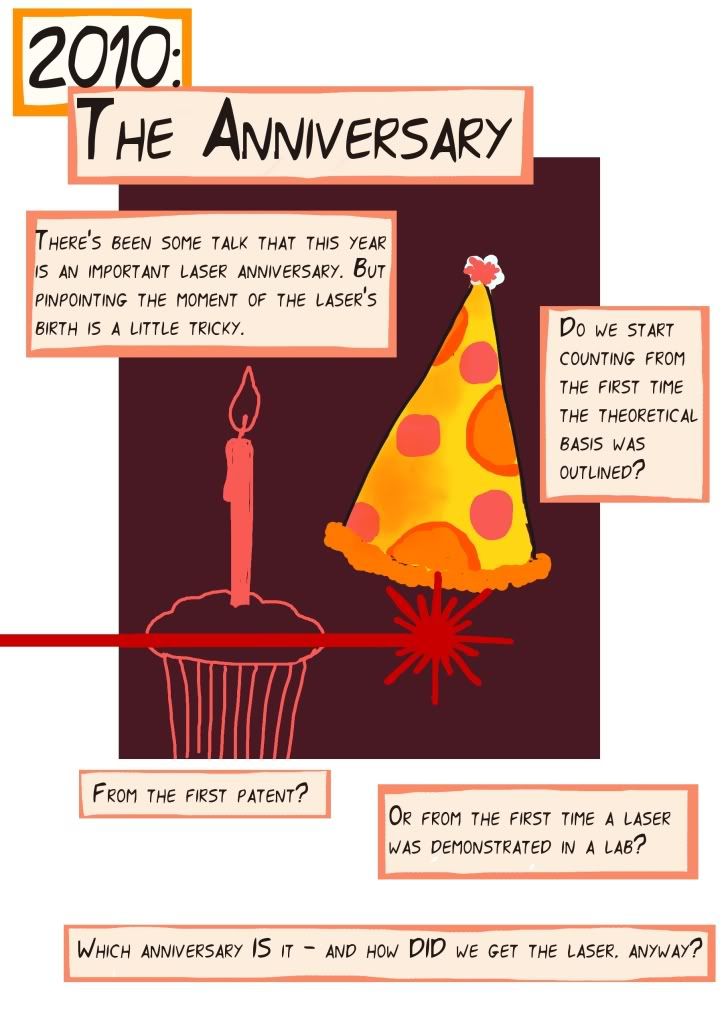
The Light Fantastic: An Illustrated History of Laser Development
Hello, everybody! Welcome to the Cambridge Science Festival blog. My name is Amali, and this is the first part of a three-part Tuesday series about LASERS.
I'm writing about lasers for two reasons: firstly because I like lasers, and secondly because the Cambridge Science Festival opens with a laser show on Saturday, April 24. I want you to be ready.
This week's topic: milestones in laser development.
The answer's under the cut...
I'm writing about lasers for two reasons: firstly because I like lasers, and secondly because the Cambridge Science Festival opens with a laser show on Saturday, April 24. I want you to be ready.
This week's topic: milestones in laser development.
The answer's under the cut...
Lunch With a Laureate: Dr. Eric Chivian
The rich intellectual environment of Cambridge has so many Nobel Laureates, and soon you'll have the unique opportunity to meet one (or more) of them! Next month, from Monday, April 26 through Friday, April 30, is the Cambridge Science Festival's week-long Lunch With a Laureate series, and the MIT Museum will host free daily lunchtime discussions with Nobel Laureates from 12-1 pm.
Thursday's lunch will be with Dr. Eric Chivian, a Harvard Medical School professor of psychiatry who co-founded the International Physicians for the Prevention of Nuclear War, which earned him the Nobel Peace Prize in 1985 for its efforts to prevent nuclear war. In addition to his attempts to prevent nuclear warfare, Chivian founded Harvard Medical School's Center for Health and the Global Environment to increase awareness of environmental change and its effects on people. The Center champions the idea that people are an essential part of the environment and that when we destroy our environment, we damage ourselves as well. Through these initiatives, Dr. Chivian continues to be active in promoting world causes 25 years after receipt of his Nobel Peace Prize.
If you attend the event, you'll be able to meet Dr. Chivian and ask him questions about his political position. You can ask him about the history of his organizations or about the factors that influenced his work. You can find out his opinion on current conflicts and the proper way to deal with the many humanitarian crises around the world, and you can get his opinion about health and public policy issues. You can also ask Dr. Chivian about how receiving the Nobel Prize changed his personal and professional life. Come armed with questions and comments and don't forget to bring your lunch!
The Basics:
Lunch With a Laureate: Eric Chivian
12-1 pm
Free
Thursday, April 29 2010
MIT Museum, 265 Massachusetts Avenue, first floor in the MIT 360 area
Thursday's lunch will be with Dr. Eric Chivian, a Harvard Medical School professor of psychiatry who co-founded the International Physicians for the Prevention of Nuclear War, which earned him the Nobel Peace Prize in 1985 for its efforts to prevent nuclear war. In addition to his attempts to prevent nuclear warfare, Chivian founded Harvard Medical School's Center for Health and the Global Environment to increase awareness of environmental change and its effects on people. The Center champions the idea that people are an essential part of the environment and that when we destroy our environment, we damage ourselves as well. Through these initiatives, Dr. Chivian continues to be active in promoting world causes 25 years after receipt of his Nobel Peace Prize.
If you attend the event, you'll be able to meet Dr. Chivian and ask him questions about his political position. You can ask him about the history of his organizations or about the factors that influenced his work. You can find out his opinion on current conflicts and the proper way to deal with the many humanitarian crises around the world, and you can get his opinion about health and public policy issues. You can also ask Dr. Chivian about how receiving the Nobel Prize changed his personal and professional life. Come armed with questions and comments and don't forget to bring your lunch!
The Basics:
Lunch With a Laureate: Eric Chivian
12-1 pm
Free
Thursday, April 29 2010
MIT Museum, 265 Massachusetts Avenue, first floor in the MIT 360 area
Subscribe to:
Posts (Atom)